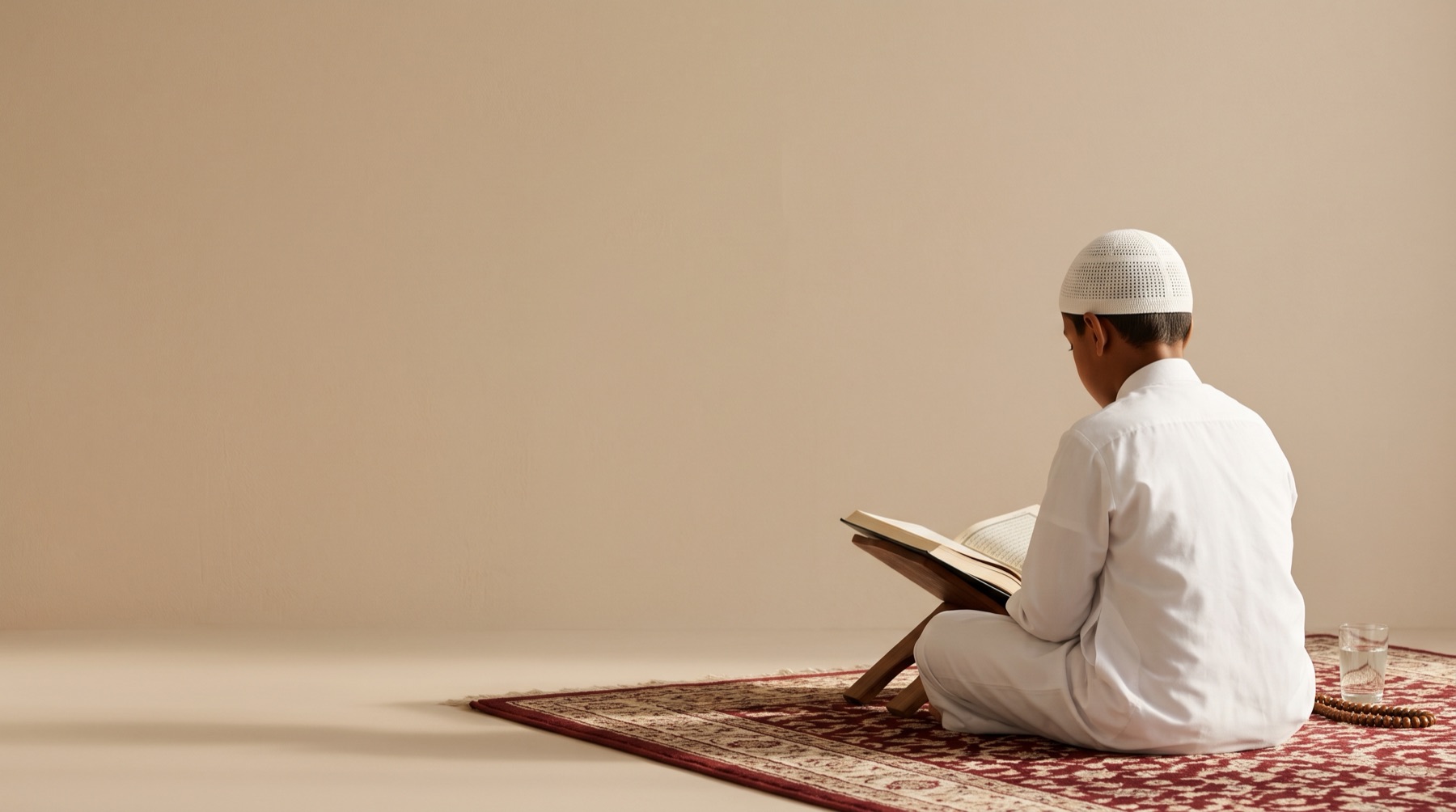

Short sessions, every day
A daily hifz routine for children works when it is small enough to happen every day. Hifz means memorising the Qur’an, and for a child it is built far more by steady repetition than by long sittings.
For most children, one short, focused session a day is enough at home, alongside their lessons with the teacher. How long depends on age: a young child may manage a few minutes before attention drifts, while an older child can sit for longer. Stop while your child still has some energy left, so they come back to it the next day without dread.
Three parts of each day
Most teachers shape a child’s daily hifz in three layers. The names vary from teacher to teacher, but the idea is the same:
The new portion
The small piece your child is learning now. They listen to it, read it from the mushaf (the printed Qur’an) and repeat it until it comes out smoothly without looking.
Recent revision
What they learnt over the last several days. This is the part most likely to slip, so it gets read aloud every day.
Older revision
Everything memorised before that, taken in turns. A little each day means every surah comes round again before it fades.
As your child memorises more, revision naturally takes up more of the time than the new portion. That isn’t slow progress. It is what keeps the earlier surahs in place.
The Prophet ﷺ said: “Keep refreshing your knowledge of the Qur’an, for by the One in whose hand is my soul, it escapes more quickly than camels from their tethers.”
Choosing a time that fits school
There is no single right hour. A good time for Qur’an memorisation is one your child can keep on school days, when they are rested enough to focus. Many families find one of these works:
- Before school. Minds are fresh and the house is often quieter. Even a few minutes after Fajr or breakfast can hold the new portion.
- After school, once they’ve had a break. Children usually need food, rest and some play first. Straight from the school bag to the mushaf rarely goes well.
- Before bed. A calm moment for listening to or reciting recent revision, rather than learning something new while tired.
You can also split the day: the new portion in the morning and revision in the evening. Whatever you choose, attach it to something that already happens, such as after a prayer or after dinner, so it becomes a habit rather than a daily negotiation.
At Radiance, lessons are set at fixed times on your family’s clock, so you can place them around school, and if a week gets busy you can move a lesson by telling us at least an hour before.
How much should a child memorise each day?
Parents often search for a number of ayahs a day. No single figure works as a rule, because ayahs differ hugely in length, and children differ even more.
What a child can memorise comfortably depends on their age, how fluently they read, how much revision they already carry and how their week is going. A young child may hold a line or two; an older, fluent reader much more. The amount should leave room for revision and still feel achievable.
That is the teacher’s call, not a target to chase. The teacher hears your child recite, sees what has stayed and what has slipped and sets the next portion to match. The portion will change over time, and sometimes the right step is to memorise nothing new for a while and strengthen what is already there.
Keeping it gentle
A routine that lasts years is one your child doesn’t resent. A few things help keep the Qur’an a warm part of the day:
- Praise effort and steadiness, not only speed or how much was memorised.
- Correct calmly, and never use memorisation as a punishment.
- On a hard day, shorten the session rather than skip it, even if it is only one quiet revision.
- Avoid comparing your child with siblings or cousins.
What parents do between lessons
You don’t need to be a teacher to help. Your role is to protect the time and be the listener. Between lessons, you can:
- Keep the daily slot free and the room quiet.
- Play a recording of the new portion by a clear reciter, so your child hears it often.
- Listen as your child recites revision, even if you follow along from the mushaf.
- Leave new material and tajweed corrections to the teacher (tajweed is the set of rules for pronouncing the Qur’an correctly), and note anything you’re unsure about to ask.
At Radiance, the teacher writes a short report after every lesson saying what was covered, where your child stopped and what to practise, so you always know what the week’s portion and revision are. Weekly and monthly tests, whose results the teacher shares, show you what has held.
Weekends and holidays
Free days can easily become days off from the Qur’an too. A lighter rhythm usually works better than stopping altogether:
- Weekends: a good moment to catch up on older revision, read slowly or recite to a grandparent.
- School holidays: some children enjoy a little more time each day; others do better keeping the usual routine. Ask the teacher before changing the pace.
- Travel and busy weeks: keep revision going, even briefly, and pause new memorisation if you need to. Coming back to a familiar routine is much easier than restarting.
Questions parents ask
What is a good daily hifz routine for children?
A short session at the same time each day, with a small new portion, a read-through of recent work and a share of older revision. The teacher sets the amounts.
What time of day is good for Qur’an memorisation?
There isn’t one right hour. Early morning suits many children, but what matters is a time your child can keep on school days, when they are rested.
How many ayahs should my child memorise a day?
There is no fixed number that fits every child. It depends on age, reading fluency and how much revision they carry, and the teacher adjusts it as they go.
How can my child balance school and hifz?
Keep the daily session short, place it before school or after a proper break and lighten new memorisation in busy weeks while keeping revision going.
Should we stop hifz during the holidays?
It’s usually better to keep a lighter routine than to stop. Even a little revision each day protects what your child has already memorised.