Start with the letters
A complete beginner, whether a child of four or an adult, starts with the Arabic letters and the sound each one makes. From there the path is the same for everyone: joining letters, then the short vowels and other marks, then reading slowly from the mushaf (the printed Qur’an). After that comes tajweed (the rules for pronouncing each letter and sound of the Qur’an correctly).
Alongside this, most beginners learn a few short surahs (chapters of the Qur’an) by listening and repeating, so the Qur’an itself is part of lessons from the first weeks, not something saved for later.
The path, step by step
Teachers may name the stages differently, and many use a primer such as the Noorani Qaida, but the order is broadly agreed:
Letters and their sounds
Every letter is learnt by sight and by sound, with attention to the points in the throat, mouth, lips and nose where each letter is made. Letters that sound alike to English speakers, such as ح and ه, or ع and ء, get extra time here.
Joining letters
Most letters change shape at the start, middle and end of a word. The learner practises recognising a letter in each position and reading two or three letters joined together.
Short vowels
The fathah, kasrah and dammah are the small marks above and below letters that give the sounds “a”, “i” and “u”. Once these are steady, the learner can read real syllables.
The other marks
Sukun (no vowel), shaddah (a doubled letter), long vowels and tanween (the doubled vowel mark that adds an “n” sound at the end of a word) follow, one at a time, each practised until it is read without hesitation.
Reading from the mushaf
The learner moves to the printed Qur’an, usually starting with short surahs from the last part (juz’). Reading is slow at first, and the teacher corrects each mistake as it happens.
Tajweed, little by little
Rules such as how long to stretch a sound, or how to say the nun before certain letters, come in as they appear in the text. That way they are learnt in use, not as a list.
How long each stage takes depends on the learner, how often they have lessons and how much they practise between them. A good teacher will not promise a date; they will tell you honestly where you stand.
Children and adults: what changes
The order is the same at any age. The way it is taught is not.
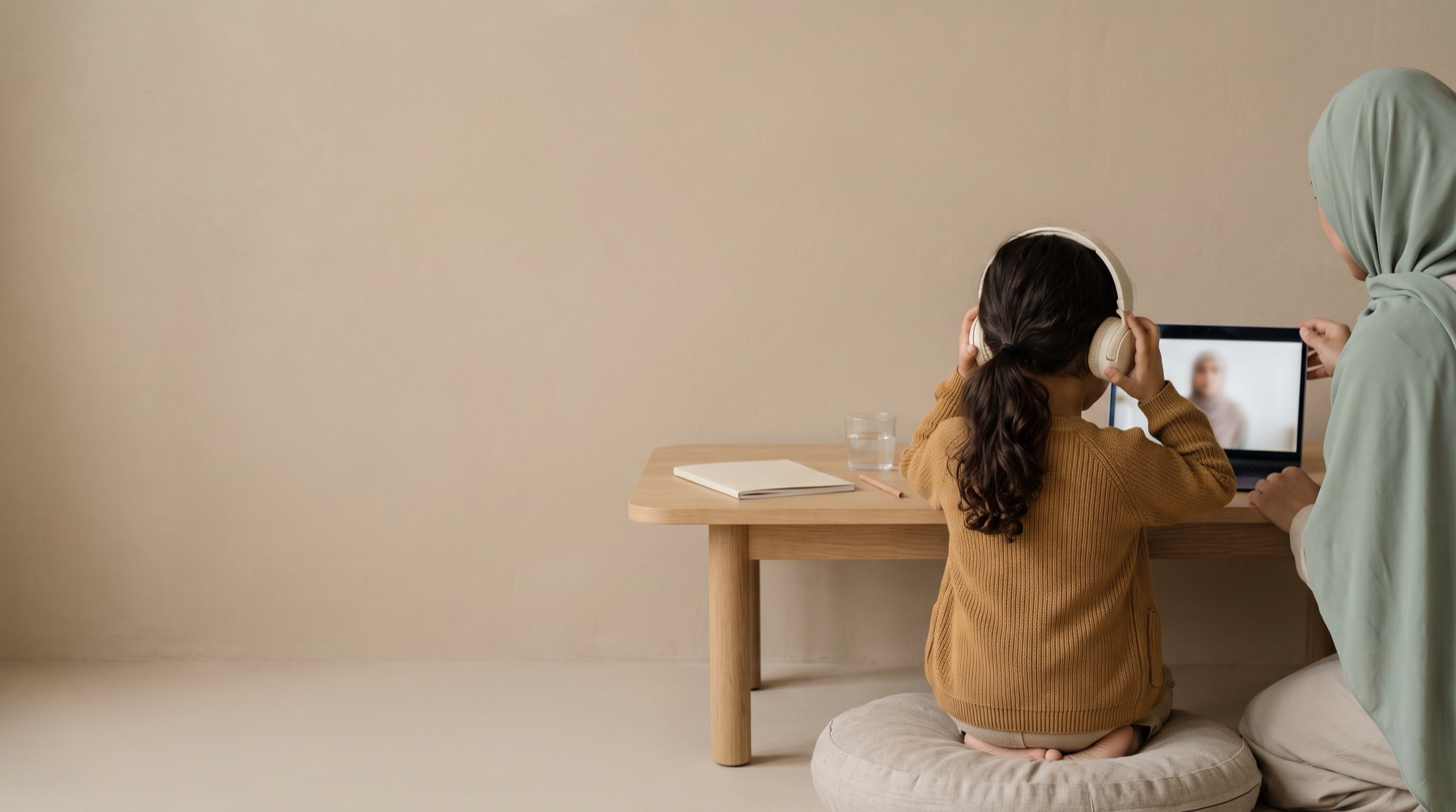
Young children learn well in short, lively stretches: a few letters at a time, lots of repetition and some praise for each small success. They often find the sounds easier than adults do, but need help to sit and focus. A parent nearby makes a real difference.
Older children and teenagers can work for longer and like to see their progress. A clear sense of the next step, and a teacher who explains why a rule matters, keeps them going.
Adults often learn the letters quickly but find some sounds harder, especially those made deep in the throat. Some feel shy about starting from zero. One-to-one lessons help here: no one else is listening, and every question can be asked.
If you are a beginner yourself and do not speak Arabic, that is no barrier. You can ask for a teacher who explains in a language you understand.
What you need to start
Very little. For live online lessons you need:
- A computer, tablet or phone with a camera and microphone. A larger screen makes small vowel marks easier to see.
- A steady internet connection and a quiet corner where the learner can hear and be heard.
- Something to read from: a primer for the early stages and a mushaf later. The teacher will tell you what to use, printed or on screen.
- A short time each day to practise, even a few minutes, on what the teacher set.
For a step-by-step look at the day itself, see what to expect in your child’s first online Qur’an lesson.
What the first lesson finds out
Many “beginners” are not quite at zero. A child may know some letters from a mosque class; an adult may read slowly but with mistakes they cannot hear. The first lesson is there to find out:
- Which letters and sounds are already secure, and which are not.
- Whether the learner can join letters and read the vowel marks.
- Whether any surahs are already memorised, and how accurately.
- How the learner responds to correction, and how long they can focus.
From this, the teacher suggests where to begin and a pace that suits the learner. Starting at the right point matters: too early and a learner gets bored; too late and gaps stay hidden.
Common mistakes at the start
Other common mistakes are relying on transliteration (Arabic written in English letters), which hides the real sounds, and learning only from recordings with no one to hear and correct the learner. Reading the Qur’an is learnt by listening to a teacher and being listened to.
It also helps to remember that struggling at the start is nothing to be ashamed of:
The Prophet ﷺ said: “The one who is skilled in the Qur’an will be with the noble and righteous scribes (the angels), and the one who recites it haltingly, finding it difficult, will have two rewards.”
How we start beginners at Radiance
Lessons are live and one-to-one on Zoom, for children aged 4–17 and for adults. The teacher from the free first lesson stays with the learner, and after every lesson you receive a written report. We teach Hafs, and Warsh as well.
Questions parents ask
What should a child learn first in Qur’an classes?
The Arabic letters and their sounds, then joining letters and the short vowels. Many children also learn Al-Fatihah and short surahs by listening at the same time.
Can an adult learn to read the Qur’an from zero?
Yes. Adults follow the same steps as children, often learning the letters quickly. One-to-one lessons let them ask anything and practise without feeling watched.
Do I need to know Arabic to start?
No. Beginners learn the letters and sounds from the start, and the teacher can explain in a language you understand.
Do we need the Noorani Qaida?
Many teachers use it or a similar primer for the early stages. The teacher will suggest what suits the learner after the first lesson.
What equipment do I need for online Qur’an classes?
A computer, tablet or phone with a camera and microphone, a steady internet connection and a quiet place. The teacher will tell you what to read from.